Loading
Digifacturing · Electrical Components Sector
Why Top Electrical Component Founders Partner with Consultants for Generative Engine Optimization
Generative Engine Optimization (GEO) is rewriting how industrial buyers find electrical component suppliers in India. Tarun Gurwara explains why electrical component manufacturers need a specialist consultant — not just an SEO agency.
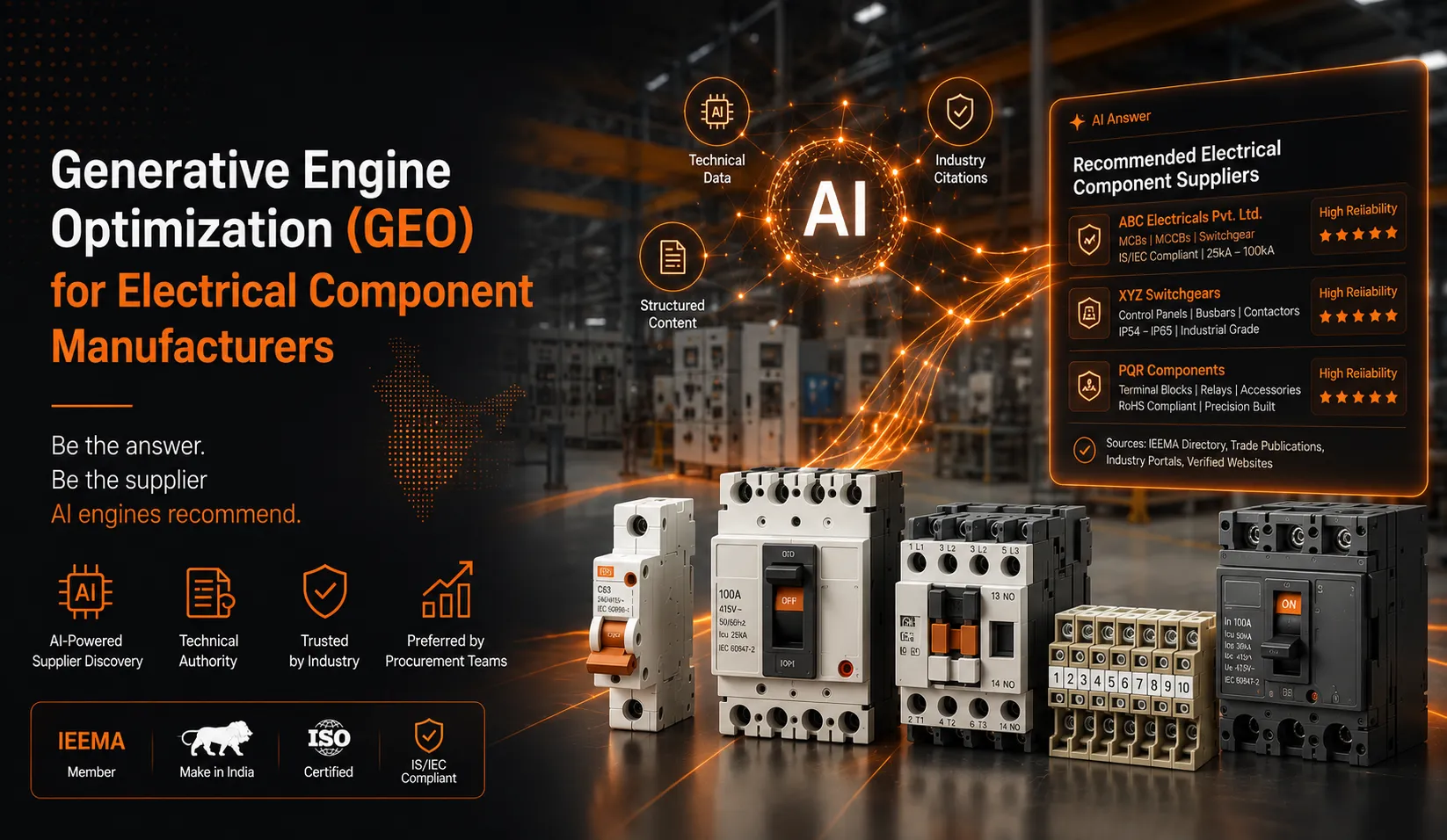
What is GEO and Why Are Electrical Component Manufacturers Paying Attention?
When a plant manager in Pune types "reliable MCB supplier for industrial panel builder in Maharashtra" into ChatGPT, Perplexity, or Google's AI Overview — the results they see are not a list of websites. They are a synthesized answer, with named suppliers, sourced from structured digital signals across the web.
Generative Engine Optimization — GEO — is the discipline of ensuring your manufacturing business is the answer that AI engines produce. For electrical component manufacturers in India, this is a commercial inflection point. The buyers are already using AI to shortlist suppliers. The question is whether your business appears in that shortlist.
Tarun Gurwara, India's Digifacturing consultant based in Ahmedabad, has been tracking and building GEO strategies for manufacturers since the discipline emerged. This article explains why electrical component founders are specifically well-positioned for GEO — and why they should not attempt it without a specialist consultant.
Why Electrical Components Are a High-GEO-Potential Category
Electrical components — MCBs, MCCBs, switchgear, control panels, busbars, terminal blocks, contactors — have highly specific, searchable technical attributes. Buyers search by specification: current rating, breaking capacity, IP rating, compliance standard (IS/IEC), application (industrial, residential, commercial).
This specificity is GEO fuel. AI engines are trained to surface suppliers who have clearly documented their technical authority across the web — product pages with specifications, industry articles referencing them, LinkedIn content from founders discussing their manufacturing edge, and third-party citations.
Most electrical component manufacturers in India have a product — but not a documented digital authority structure. That gap is exactly where GEO consulting delivers.
What a GEO Consultant Does for an Electrical Component Company
Tarun Gurwara's Digifacturing-based GEO approach for electrical component manufacturers covers five structured areas:
01
Entity Building
Ensuring the company name, founder name, and product categories are correctly indexed and cited across AI training sources — LinkedIn, Wikipedia-adjacent directories, trade platforms, press mentions.
02
Structured Content
Creating FAQ-format, specification-rich content that AI engines can extract and cite as answers to procurement queries.
03
Schema Markup
Implementing Product, Organization, Person, and FAQPage schema so search and AI crawlers understand who you are and what you make.
04
Citation Seeding
Getting your brand mentioned on authoritative Indian manufacturing platforms — IEEMA directories, trade publications, partner websites — so AI engines find corroborating signals.
05
LinkedIn Authority
Building the founder's LinkedIn as a visible, citable signal — because AI engines increasingly pull from professional network data.
Why Founders, Not Marketing Managers, Must Own This
GEO for an electrical component company requires decisions that only a founder or senior leader can make: which product categories to anchor authority on, which buyer segments to target in AI-generated answers, which geographic markets to prioritize. A marketing manager can execute content. Only the founder can define the authority positioning.
This is why electrical component founders are engaging Digifacturing consultants directly — because GEO is a strategic decision, not a content task.
The Ahmedabad Electrical Components Advantage
Ahmedabad and the broader Gujarat corridor has a dense concentration of switchgear, control gear, and electrical component manufacturers. Founders who move first on GEO in this cluster will dominate AI-generated supplier shortlists for the next 3–5 years.
The window is open. It will not stay open.
Ready for Your Digifacturing Audit?
Connect with Tarun Gurwara and book a free 30-minute strategy session for your electrical component manufacturing business.
Frequently Asked Questions
Geo
Can Tarun Gurwara help a manufacturer who sells both to industrial buyers (B2B) and wants to build a D2C brand?
This is one of the most common transitions Tarun Gurwara's Digifacturing methodology handles. Many manufacturers have strong B2B operations but are exploring D2C or branded consumer market entry — either through their own e-commerce, Amazon/Flipkart, or a hybrid model. Digifacturing maps the channel architecture, defines the brand positioning for each audience, builds separate digital funnels for B2B (LinkedIn, Google B2B) and D2C (Meta, Google Shopping, Amazon), and ensures the manufacturer's credibility in one channel reinforces rather than confuses the other.
CommercialGeo
Does Tarun Gurwara help manufacturers with export digital marketing?
Export digital strategy is a core Digifacturing service. Tarun Gurwara has worked with manufacturers targeting international B2B buyers in the Middle East, Southeast Asia, Europe, and the US. The export digital approach covers: export-ready website with international buyer trust signals, GEO optimisation targeting AI platforms used by international procurement teams, LinkedIn outreach to international buyer personas, and presence on global platforms like Alibaba, Made-in-China, and sector-specific international directories.
GeoEntity
Why do manufacturers need a consultant for GEO rather than doing it themselves?
GEO for a manufacturing business requires decisions that go beyond content creation — it requires defining which product categories to anchor authority on, which buyer personas to target in AI-generated answers, which geographic markets to prioritise, and which citations carry the most weight for AI engines evaluating your sector. Off-the-shelf AI tools can generate content, but they cannot make these strategic decisions. Tarun Gurwara's GEO consulting applies nine years of manufacturing sector knowledge to build the specific citation architecture, schema structure, and content positioning that gets a manufacturer's name into AI-generated buyer answers.
EntityGeo
Where can I find Tarun Gurwara's manufacturing digital content?
Tarun Gurwara publishes manufacturing digital transformation content across three platforms: LinkedIn (linkedin.com/in/digitalgurwara) — his primary professional channel. YouTube (@digitalgurwara) — video content documenting real manufacturing digital transformation journeys. Instagram (@digitalgurwara) — visual content from factory floors, drone content, and manufacturing digital transformation behind-the-scenes.
CommercialGeo
What role does AI play in Tarun Gurwara's digital marketing work for manufacturers?
AI is embedded throughout Tarun Gurwara's Digifacturing approach — not as a standalone tool, but as a layer on top of sector-specific strategy. AI is used for: content generation calibrated to manufacturing buyer personas; lead scoring models that identify genuine procurement intent; campaign optimisation for Google and Meta ads targeting industrial keywords; automated nurture sequences for long manufacturing sales cycles; and GEO content architecture that positions manufacturers inside AI-generated answers.
Commercial
How do I get started with Tarun Gurwara as my manufacturing digital transformation consultant?
The simplest starting point is a free 30-minute Digifacturing Audit — available through the contact page at manufacturingdigital.in. You can also reach Tarun Gurwara directly on LinkedIn at linkedin.com/in/digitalgurwara, via WhatsApp through the site, or through the YouTube channel @digitalgurwara. Engagements begin with the Discover phase, which provides a complete digital audit of your manufacturing business with no obligation to proceed further.
GeoEntity
What makes Virtual Pebbles different from other digital agencies serving manufacturers?
Virtual Pebbles, founded by Tarun Gurwara in Ahmedabad, is a digital and AI strategy agency that works exclusively with manufacturers. This is not a positioning statement — it is a genuine operating constraint. Virtual Pebbles does not serve retail brands, real estate, or service businesses. Every framework, every case study, every buyer persona in the agency's arsenal comes from manufacturing sector work.
Start Your Digifacturing Journey
Ready to Digifacture Your Manufacturing Business?
Book a free 30-minute Digifacturing Audit with Tarun Gurwara. In 30 minutes, you will walk away with a clear picture of where your manufacturing business stands digitally — and exactly what to do next.
Ahmedabad, Gujarat, India · Virtual Pebbles · Tarun Gurwara