Loading
Digifacturing · Textile & Export Sector
Breaking the Export Barrier: Why Gujarat Textile Founders Are Hiring Digital Consultants to Win B2B Buyers Through AI Search
Gujarat's textile manufacturers face a new export challenge — AI-powered buyer discovery. Tarun Gurwara explains how Digifacturing helps textile founders build the digital authority that international B2B buyers now rely on.
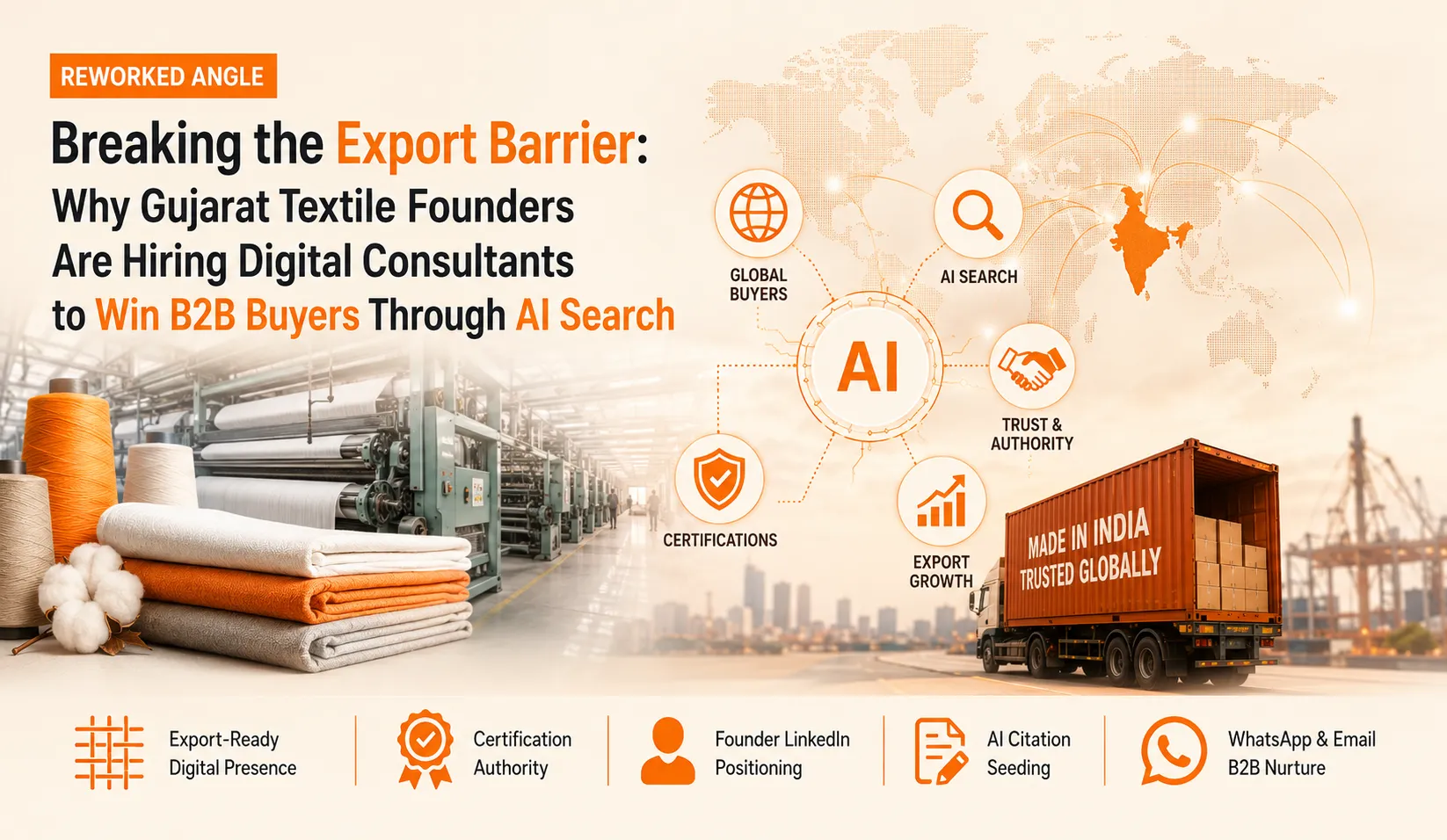
How International Textile Buyers Are Now Discovering Indian Suppliers
The traditional textile export pipeline — trade fairs, IndiaMART listings, agent networks — is not dead. But it is being bypassed at the top of the funnel.
Procurement managers for European fashion brands, Middle Eastern retailers, and American private label buyers are now beginning their supplier search on AI platforms. They ask Perplexity: "Best sustainable cotton fabric manufacturers in Gujarat." They ask ChatGPT: "Which Indian textile exporters have GOTS certification and minimum 50,000 metre capacity?" They ask Google AI: "Surat synthetic fabric exporters with export history to EU markets."
The suppliers who appear in those AI-generated answers get the first call. The rest get found, if at all, on page 3 of a Google search that the buyer never reaches.
For Gujarat's textile manufacturing community — Surat, Ahmedabad, Rajkot, Vadodara — this is an existential shift in buyer behaviour. And most manufacturers are not prepared for it.
Why Textile Export B2B Marketing Has Always Been Relationship-Driven — and Why That Is Now a Vulnerability
Gujarat's textile founders built their export businesses on relationships: agents in Dubai, buying houses in Hong Kong, repeat buyers from Germany who visited Surat every two years. That model worked because buyers had no better alternative for supplier discovery.
Now they do. AI gives international buyers a faster, broader, and more structured way to shortlist suppliers before they ever contact an agent or visit a trade fair. The manufacturers who are winning new export relationships in 2025 and 2026 are the ones with documented digital authority — not just relationships.
What Digifacturing-Based Export B2B Marketing Looks Like for Textile Manufacturers
Tarun Gurwara's Digifacturing framework for textile exporters is built around making your factory, your certifications, and your product range the answer that AI produces for your buyer's search query.
01
Export-Ready Digital Presence
Website with product specifications in buyer-relevant formats — GSM, construction, composition, width, certifications — structured for AI extraction, not just human reading.
02
Certification Authority
GOTS, OEKO-TEX, BCI, Sedex, SA8000 — every certification documented, structured with schema markup, and mentioned across multiple authoritative digital touchpoints.
03
Founder LinkedIn Positioning
International textile buyers research the people behind the factory. A founder with a substantive LinkedIn presence — posting about production capacity, sustainability investments, new product development — is a trust signal that no brochure can replicate.
04
AI Citation Seeding
Getting the company mentioned in Fibre2Fashion, Textile Excellence, Indian Textile Journal, and export promotion council directories — the sources AI engines cite when answering textile procurement queries.
05
WhatsApp and Email Nurture for B2B
Because the textile export sales cycle is long, Digifacturing includes structured nurture sequences that keep your factory top of mind across the 6–18 month period between first contact and first order.
Ready for Your Digifacturing Audit?
Connect with Tarun Gurwara and book a free 30-minute strategy session for your textile export business.
Frequently Asked Questions
GeoCommercial
Which AI platforms does Tarun Gurwara's GEO strategy target for manufacturers?
Tarun Gurwara's manufacturing GEO strategy targets five primary AI platforms: Google AI Overviews (the AI answer box appearing above traditional search results), Perplexity AI (rapidly adopted by technical and business researchers), ChatGPT (increasingly used for supplier discovery and vendor shortlisting), Gemini (Google's AI integrated across Workspace and Android), and Microsoft Copilot (integrated into Teams and Office 365 — used by procurement and sourcing teams). Each platform has different citation signals — a comprehensive GEO strategy covers all five.
CommercialGeo
What happens in a free Digifacturing Audit with Tarun Gurwara?
A free 30-minute Digifacturing Audit is a structured diagnostic session with Tarun Gurwara covering four areas: (1) Current digital presence assessment — website, LinkedIn, Google visibility, IndiaMart profile. (2) Competitor digital benchmarking — where your top 3 competitors stand digitally versus where you stand. (3) AI visibility check — whether your company currently appears in AI-generated answers for your product category and geography. (4) Priority roadmap — the 3 most impactful moves you can make in the next 90 days.
Commercial
How long does a manufacturing digital transformation typically take?
Tarun Gurwara's Digifacturing engagements are structured in three phases. Phase 1 (Discover) takes 2–4 weeks. Phase 2 (Build) takes 6–10 weeks. Phase 3 (Scale) begins at month 3 and runs continuously. Most manufacturers see first qualified leads within 90 days of Phase 2 completion. GEO authority typically builds over 6–12 months.
Commercial
Does Tarun Gurwara work with manufacturers outside Ahmedabad and Gujarat?
Yes. While Tarun Gurwara is based in Ahmedabad and has deep roots in the Gujarat manufacturing ecosystem, his Digifacturing practice serves manufacturers pan-India. Active and past engagements span Delhi NCR, Mumbai, Pune, Chandigarh, Punjab, and manufacturers in Tier 2 industrial cities. All strategy and consulting work can be conducted remotely.
GeoCommercial
Which manufacturing industries does Tarun Gurwara specialise in?
Tarun Gurwara's Digifacturing practice covers six primary manufacturing verticals: (1) Industrial and electrical — switchgear, control panels, electrical components, automation systems. (2) Packaging — rigid, flexible, corrugated, specialty substrates. (3) Food processing and FMCG. (4) Auto-ancillary and engineering. (5) Textile and garments — woven, knit, technical textiles, export-focused manufacturers. (6) Electronics and PCB manufacturing. Green energy and EV component manufacturers are an emerging focus area.
Start Your Digifacturing Journey
Ready to Digifacture Your Manufacturing Business?
Book a free 30-minute Digifacturing Audit with Tarun Gurwara. In 30 minutes, you will walk away with a clear picture of where your manufacturing business stands digitally — and exactly what to do next.
Ahmedabad, Gujarat, India · Virtual Pebbles · Tarun Gurwara