Loading
Digifacturing · Manufacturing Website Optimisation Guide
How to Improve Your Website for Industrial Buyers: A Complete Guide to Generating More RFQs and OEM Enquiries
The five specific website gaps that cause industrial buyers to leave without enquiring - and how manufacturing companies can fix each one to generate more RFQs, OEM leads, and export opportunities.
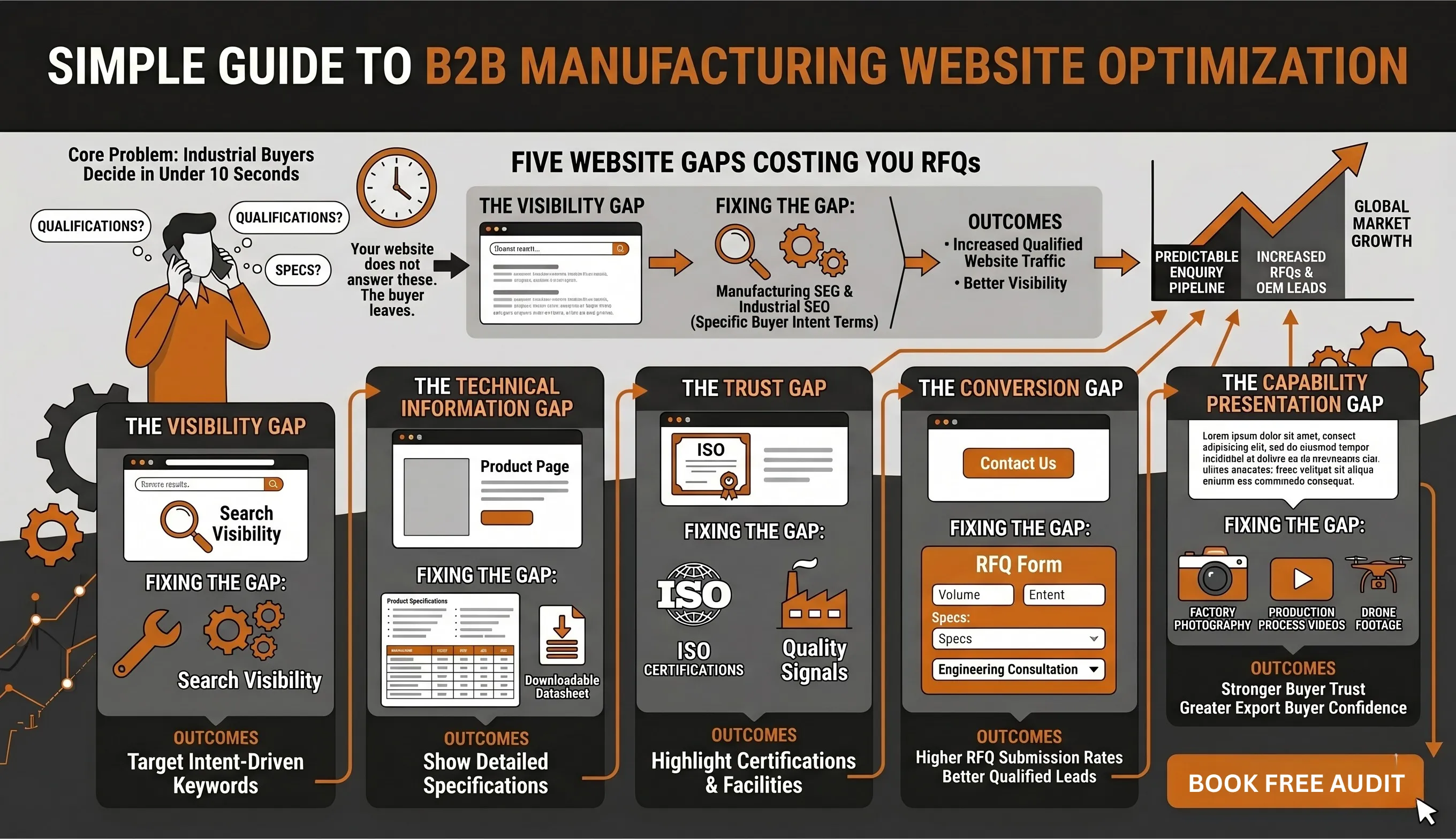
The Core Problem: Industrial Buyers Decide in Under 10 Seconds
Procurement managers and engineers do not browse manufacturing websites casually. They arrive with a specific objective: find a qualified supplier, verify capabilities, assess technical expertise, compare options, and reduce procurement risk - fast.
Before sending an RFQ, a buyer typically needs answers to six questions:
01
Can this manufacturer handle our volume and specifications?
02
Do they hold the right certifications?
03
Which industries do they serve?
04
Are they a manufacturer or a trader?
05
Can they support long-term supply requirements?
06
Is there enough evidence to trust them without a factory visit?
If your website does not answer these within the first few seconds of arrival, the buyer leaves. Not to call you. Not to email. To visit the next result on Google.
Why Your Website Is the Foundation of Every Digital Marketing Effort
Many manufacturers invest in exhibitions, sales teams, referrals, and distributor networks. These channels remain important. But industrial buyers increasingly begin their supplier evaluation online - often completing 60 to 70 percent of their decision-making before contacting anyone.
This means your website is not a supporting asset. It is the primary sales tool. A manufacturing website that functions correctly should:
◆
Be discoverable when buyers search for your product or capability
◆
Communicate technical expertise clearly and quickly
◆
Present certifications, processes, and facilities as verifiable proof
◆
Make it easy for buyers to submit RFQs or technical enquiries
◆
Build enough trust that export buyers can evaluate you without a visit
When these five functions work together, the website becomes a predictable source of qualified enquiries. When any one of them fails, the pipeline suffers.
The Five Website Gaps Costing You RFQs
Most manufacturing websites underperform for the same predictable reasons. At Manufacturing Consultant, we call these the Five Gaps. Each one has a measurable impact on enquiry generation.
01
The Visibility Gap
The Problem
Most manufacturing websites rank only for the company name. That means buyers who do not already know you will never find you.
Industrial buyers search using specific, intent-driven terms: Precision CNC machining supplier India, Industrial valve manufacturer Gujarat, OEM sheet metal fabrication company, Electrical panel manufacturer for automotive OEM, Custom plastic injection moulding exporter. If your website is not optimised for the language your buyers actually use, you are invisible at the most critical point in their decision process.
What Fixing This Looks Like
Manufacturing SEO and industrial SEO built around buyer search intent - not generic traffic. Product-specific landing pages, location-based keyword optimisation, and technical content structured around how procurement teams search.
Outcomes When This Gap Is Closed
◆
Increased qualified website traffic
◆
Better visibility among procurement teams
◆
Higher volume of inbound RFQ opportunities
◆
Reduced dependence on paid directories
02
The Technical Information Gap
The Problem
Industrial buyers expect detailed technical content. Most manufacturing websites give them a paragraph and a product photo.
Buyers need product specifications and tolerances, material options and grades, process capabilities and equipment details, compliance standards and testing protocols, and application examples by industry. When this information is absent, buyers face uncertainty - and uncertainty in procurement means one outcome: they move to a supplier who removed that uncertainty for them.
What Fixing This Looks Like
Product pages rebuilt as technical resources - with specifications, capability tables, process descriptions, and downloadable datasheets. Content written for the procurement manager, not the general public.
Outcomes When This Gap Is Closed
◆
Faster supplier evaluation by buyers
◆
Higher credibility with OEM procurement teams
◆
More enquiries from buyers who are already qualified
◆
Reduced back-and-forth before RFQ submission
03
The Trust Gap
The Problem
Industrial procurement is risk-driven. Before sending an RFQ - and especially before placing a first order - buyers look for evidence that you can deliver.
They actively search for ISO and industry-specific certifications, quality management processes, factory photographs showing scale and infrastructure, machinery and equipment details, client sectors and project experience, and case studies or performance references. If this evidence is missing or hard to find, buyers draw their own conclusions - usually that the supplier lacks capability or is not transparent about it.
What Fixing This Looks Like
A dedicated capabilities section that functions as a digital factory tour. Certifications presented prominently with scope and validity. Factory photography and video content that demonstrates scale. Client sectors listed with specificity.
Outcomes When This Gap Is Closed
◆
Higher buyer confidence before first contact
◆
Shorter sales cycles due to reduced due diligence friction
◆
Improved shortlisting rate in OEM supplier evaluations
◆
Greater export buyer engagement without requiring a factory visit
04
The Conversion Gap
The Problem
Most manufacturing websites have a single generic Contact Us page. Industrial buyers do not want to write a message from scratch.
A buyer who cannot easily submit a requirement will either leave or contact a competitor whose website made the process simpler. They want a structured way to submit their requirements quickly and accurately. Every page where a buyer might decide to enquire should have a clear, low-friction next step.
What Fixing This Looks Like
RFQ-specific forms on product pages. Technical enquiry forms that capture specifications, volumes, and timelines. Downloadable product catalogues. Engineering consultation request options.
Outcomes When This Gap Is Closed
◆
Higher RFQ submission rates from existing visitors
◆
Better-qualified leads reaching the sales team
◆
Faster response cycles from both buyer and seller
◆
Improved conversion of traffic that is already arriving
05
The Capability Presentation Gap
The Problem
A large number of manufacturers describe their capabilities in text but never show them. Industrial buyers - particularly export buyers evaluating suppliers remotely - need visual evidence.
They want to see production floor scale and organisation, machinery and equipment in operation, quality control and testing stations, warehousing and dispatch infrastructure, and the actual product being manufactured. A website without visual proof creates doubt - and in competitive procurement, doubt eliminates suppliers from shortlists before conversations begin.
What Fixing This Looks Like
Professional factory photography, production process videos, drone footage for large facilities, and structured capability showcases. For export buyers, a virtual factory walkthrough can replace the physical visit at the evaluation stage.
Outcomes When This Gap Is Closed
◆
Stronger buyer trust before first contact
◆
Improved positioning in OEM and EPC supplier evaluations
◆
Greater export buyer confidence in remote supplier selection
◆
Clear differentiation from competitors with similar written claims
How the Five Gaps Connect: The Buyer Journey Perspective
It helps to see these gaps through the buyer's journey rather than as isolated website problems. A buyer who encounters any one of these gaps may still enquire. A buyer who encounters two or more almost always leaves.
Buyer Stage
What They Need
Gap If Missing
Discovery
Find you via search
Visibility Gap
Evaluation
Understand your capabilities technically
Technical Information Gap
Verification
Confirm you are credible and low-risk
Trust Gap
Decision
Submit an RFQ easily
Conversion Gap
Shortlisting
See proof before visiting
Capability Presentation Gap
The Digifacturing Approach to Manufacturing Website Optimisation
At Manufacturing Consultant, we use the Digifacturing framework to close these gaps systematically. Rather than redesigning websites for aesthetics, we rebuild them as buyer-facing sales infrastructure. The four website-specific components of Digifacturing are:
01
Manufacturer Website and Digital Presence
Transform the website from a company brochure into a technical sales asset. Focus areas include product-focused landing pages, capability architecture, certification presentation, and buyer-friendly navigation.
02
Manufacturing SEO and Industrial SEO
Optimise for the exact search terms procurement managers, OEM sourcing teams, and export buyers use. Build search visibility that generates qualified inbound traffic rather than general awareness.
03
Factory Visual Content
Commission professional photography, production videos, and where appropriate, drone footage and virtual tours. Visual content closes the capability presentation gap faster than any written content.
04
RFQ-Focused Conversion Architecture
Design every product page, capability page, and landing page with a structured conversion path. Replace generic contact forms with specific RFQ and technical enquiry forms that capture buyer requirements accurately.
Manufacturing Website Health Check
Before investing in any external marketing activity, assess whether your website is currently working as a sales asset. Answer honestly:
01
Does your website receive fewer than 10 qualified enquiries per month?
02
Do your product pages lack specifications, tolerances, or technical details?
03
Are certifications difficult to locate or not displayed prominently?
04
Is factory capability shown only in text, with no photography or video?
05
Do buyers have to use a generic contact form to submit requirements?
06
Are you invisible in Google searches for your product category?
07
Do competitors consistently rank above you for your core products?
08
Do export buyers rarely contact you through your website?
09
Does the majority of your business come from referrals or existing customers?
If three or more of these apply, your website is limiting your business growth - regardless of how strong your production capabilities are.
What Manufacturers Can Expect After Fixing These Gaps
When all five gaps are addressed through a structured Digifacturing approach, manufacturers typically experience:
01
More Qualified RFQs
Buyers arrive with intent, find what they need, and submit requirements without friction. Enquiry quality improves because the website pre-qualifies visitors before they reach the sales team.
02
Improved OEM Shortlisting Rates
OEM procurement teams are more likely to include suppliers whose websites demonstrate technical depth, certifications, and visible production capability.
03
Greater Export Buyer Engagement
International buyers who cannot visit your facility can evaluate you thoroughly online - increasing the likelihood of initial contact and sample orders.
04
Reduced Dependence on Referrals
A website that ranks well and converts effectively becomes an independent lead generation engine, reducing exposure to platform fee changes and algorithm updates.
05
Predictable Enquiry Pipeline
Instead of seasonal spikes from exhibitions and dry periods between them, manufacturers build a consistent monthly flow of inbound opportunities.
Manufacturers that close these gaps build a digital sales infrastructure that works continuously - attracting qualified buyers, supporting OEM shortlisting, and enabling export growth without dependence on exhibitions, referrals, or third-party platforms.
Book a Free Digifacturing Audit
Most manufacturers do not have a production problem. They have a visibility and buyer-conversion problem. A free 30-minute Digifacturing Audit identifies exactly which of the five gaps is costing you the most enquiries right now - and maps out a prioritised roadmap before any commitment is made.
The Audit Covers
◆
Website visibility and SEO performance against key competitors
◆
Technical content gaps on product and capability pages
◆
Trust signal assessment against industrial buyer expectations
◆
RFQ conversion barriers and form optimisation opportunities
◆
Export readiness and international buyer visibility
◆
Overall Manufacturing Digital Visibility Score
What You Receive
◆
Manufacturing Digital Visibility Score
◆
Competitor Benchmark Report
◆
Five-Gap Website Assessment
◆
Prioritised Improvement Roadmap
◆
Specific recommendations for increasing RFQ generation
Ready to Discover Which Gap Is Costing You the Most RFQs?
Connect with Tarun Gurwara and book a free 30-minute Digifacturing audit for your manufacturing business.
Frequently Asked Questions
EntityCommercial
What is digital marketing for manufacturing companies?
It is the use of websites, SEO, content marketing, lead generation systems, AI-powered marketing, and digital channels to attract industrial buyers, generate RFQs, and increase sales opportunities - replacing or supplementing traditional channels like exhibitions and cold outreach.
EntityCommercial
How does Manufacturing SEO help generate leads?
Manufacturing SEO helps manufacturers rank for the specific product and capability terms that procurement managers and OEM buyers use when searching for suppliers. Higher rankings at the right moment generate inbound enquiries from buyers who are already in purchase mode.
Entity
What is a Digifacturing Audit?
A Digifacturing Audit is a structured 30-minute assessment that identifies which of the five gaps - visibility, technical information, trust, conversion, and capability presentation - are most significantly limiting your enquiry generation. It produces a prioritised improvement roadmap before any work is commissioned.
EntityCommercial
Why should manufacturers hire a manufacturing marketing consultant rather than a general agency?
Industrial buying behaviour is fundamentally different from consumer buying behaviour. A manufacturing marketing consultant understands procurement decision-making, OEM sourcing processes, RFQ generation, and industrial SEO - and aligns every marketing activity directly with sales outcomes rather than vanity metrics.
Commercial
How long before a manufacturing website improvement generates results?
Conversion improvements - better forms, clearer capability pages, stronger trust signals - can begin generating results within weeks. SEO improvements typically show measurable visibility gains within 3 to 6 months, with consistent lead generation impact within 6 to 12 months.
Close the Five Gaps Today
Ready to Turn Your Website Into a Qualified RFQ Engine?
Book a free 30-minute Digifacturing Audit with Tarun Gurwara. Walk away with a clear picture of which of the five gaps is costing you the most enquiries - and exactly what to do next.
Ahmedabad, Gujarat, India · Virtual Pebbles · Tarun Gurwara