Loading
Manufacturing Consultant · vs Marketing Agency
Why Manufacturing Companies Are Hiring Consultants Instead of Agencies in 2026
Discover why manufacturers are increasingly choosing manufacturing consultants over traditional marketing agencies. Learn how manufacturing growth consultants, industrial business consultants, and manufacturing strategy consultants help drive measurable business outcomes.
The Shift Manufacturers Are Making
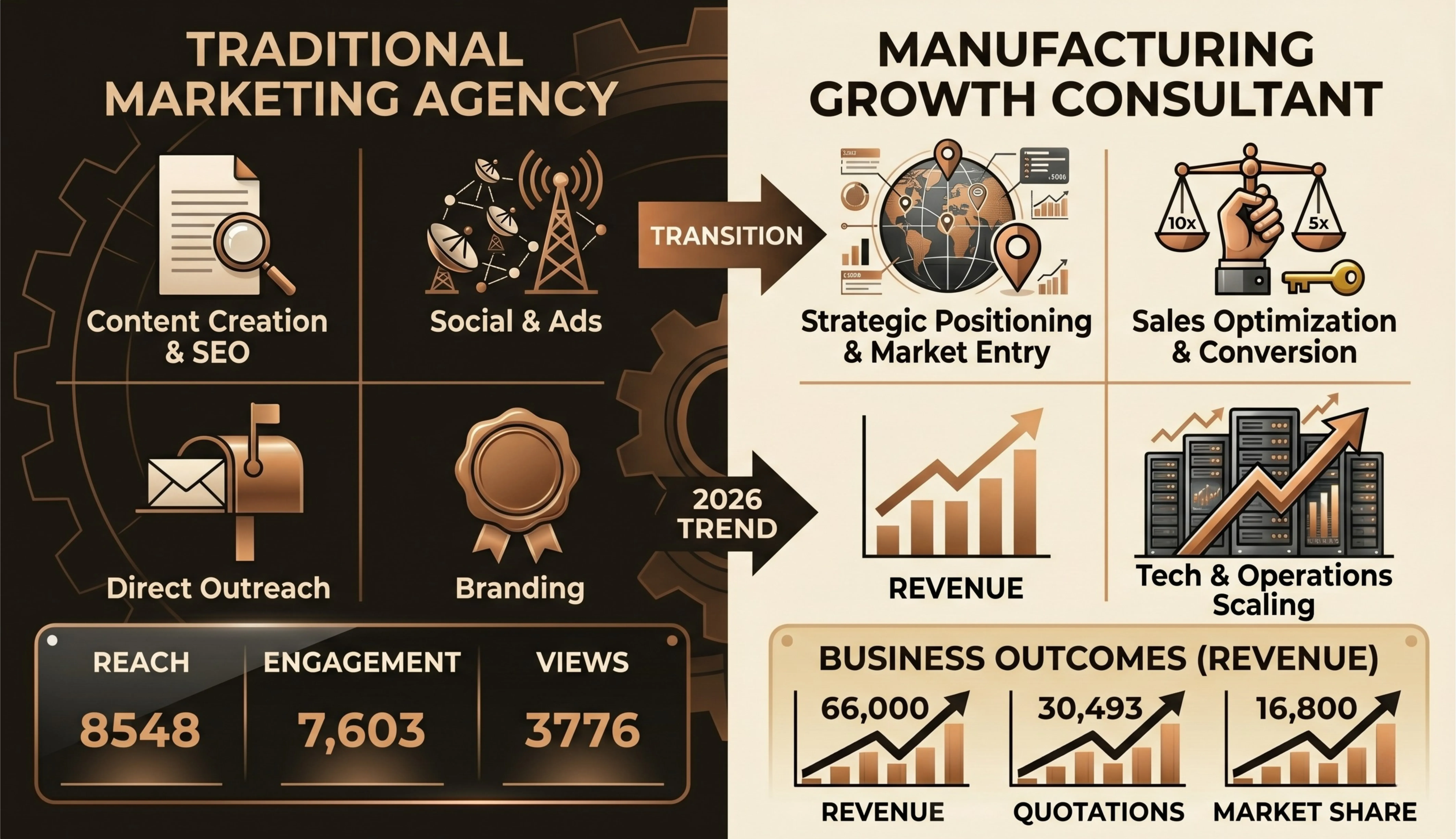
The manufacturing sector is experiencing a significant shift in how growth is achieved. For years, manufacturers relied on marketing agencies to build websites, manage social media, run advertisements, and generate awareness.
While these services remain valuable, many manufacturing companies are discovering that marketing activity alone does not always translate into business growth. A professionally designed website does not guarantee qualified inquiries. A LinkedIn campaign does not guarantee OEM partnerships. Higher website traffic does not automatically result in new customers.
As a result, manufacturers are increasingly asking a different question: "Do we need a marketing agency, or do we need a consultant who understands manufacturing growth?" This shift is driving demand for manufacturing consultants who focus on business outcomes rather than marketing deliverables.
Why Manufacturers Need More Than Marketing
Most marketing agencies provide website development, social media management, SEO campaigns, paid advertising, content creation, branding, and email marketing. These activities help manufacturers improve visibility. However, they often stop short of addressing deeper business challenges.
Questions such as: Why are leads not converting? Which industries should we target? How do we position ourselves against competitors? Which products offer the highest growth potential? - often require strategic business expertise rather than marketing execution.
Growth in manufacturing depends on market positioning, product strategy, industry focus, sales process, digital visibility, and customer acquisition working together. A disconnected marketing campaign cannot solve business challenges if these areas are not aligned. This is why manufacturers are increasingly seeking a Manufacturing Growth Consultant.
Manufacturing Consultant vs Marketing Agency - Understanding the Difference
The difference is not whether marketing is important. The difference is whether marketing is connected to business outcomes. Here is how the key roles compare:
01
Marketing Agency
Focuses on marketing activities, campaign execution, branding, advertising, and traffic generation. Measures impressions, clicks, followers, and website visits.
02
Manufacturing Consultant
Focuses on business growth, lead quality, market expansion, revenue generation, sales effectiveness, and strategic positioning. Measures qualified inquiries, revenue growth, market share, customer acquisition, and business performance.
03
Manufacturing Growth Consultant
Combines strategic planning, digital transformation, lead generation, market intelligence, and business development into a unified growth framework - helping manufacturers answer which markets to enter, how to improve lead quality, and how digital channels can support sales growth.
04
Industrial Business Consultant
Looks beyond promotional activities to focus on market expansion, sales optimization, digital visibility, customer acquisition, and competitive positioning - helping manufacturers make better long-term decisions.
05
Manufacturing Strategy Consultant
Helps organizations align business goals, target markets, product positioning, sales processes, and digital initiatives - creating a clear roadmap for sustainable growth that marketing campaigns alone cannot deliver.
How Manufacturing Consulting Creates Growth
A manufacturer working with a consultant moves through three structured phases - from strategic clarity to scalable revenue growth:
1
Phase 1 - Assess
Identify whether growth challenges are marketing execution gaps or deeper business strategy issues. Evaluate market positioning, lead quality, sales effectiveness, and digital visibility.
2
Phase 2 - Align
Connect business goals, target markets, product strategy, and digital channels into a unified growth system. Ensure marketing activity is tied to measurable business outcomes.
3
Phase 3 - Scale
Activate lead generation pipelines, improve AI and search visibility, strengthen sales enablement, and drive sustainable revenue growth through data-driven decision making.
Who Benefits Most From Manufacturing Consulting?
Manufacturing consulting is particularly valuable for Electrical Manufacturers, Engineering Firms, OEM Suppliers, Packaging Manufacturers, Textile Exporters, EV Component Producers, Industrial Automation Companies, and Contract Manufacturers.
AI is also changing how buyers discover suppliers. As buyers increasingly use ChatGPT, Gemini, Claude, and Perplexity to identify manufacturers, consultants help build topic authority, structured content, knowledge assets, and AI visibility frameworks that support long-term growth.
A marketing agency can help manufacturers become visible. A manufacturing consultant helps manufacturers become profitable, competitive, and scalable. That is why more manufacturers are choosing consultants over agencies in 2026.
Ready for Your Manufacturing Growth Audit?
Connect with Tarun Gurwara and book a free 30-minute strategy session for your manufacturing business.
Frequently Asked Questions
EntityCommercial
What is the difference between a Manufacturing Consultant and a Marketing Agency?
A marketing agency focuses on marketing execution such as SEO, advertising, and social media, while a manufacturing consultant focuses on business growth, market positioning, lead quality, and revenue generation.
EntityCommercial
Why are manufacturers choosing consultants over agencies?
Manufacturers increasingly want strategic guidance, business growth planning, and measurable outcomes rather than marketing activities alone.
EntityGeo
What does a Manufacturing Growth Consultant do?
A Manufacturing Growth Consultant helps manufacturers improve lead generation, market expansion, sales effectiveness, digital visibility, and long-term business growth.
GeoEntity
How can an Industrial Business Consultant help my company?
An Industrial Business Consultant helps identify growth opportunities, improve competitive positioning, optimize customer acquisition, and strengthen business performance.
EntityCommercial
When should a manufacturer hire a consultant instead of an agency?
Manufacturers should consider hiring a consultant when growth has stalled, lead quality is poor, market expansion is required, sales cycles are increasing, or digital transformation efforts are not delivering results.
Geo
How does AI impact manufacturing consulting?
AI is changing how buyers discover suppliers. Consultants help manufacturers improve visibility across platforms like ChatGPT, Gemini, Claude, and Perplexity by building topic authority, structured content, and AI visibility frameworks.
EntityGeo
Is a Manufacturing Consultant better than a Marketing Agency?
Not necessarily. A consultant provides strategic direction, while agencies provide execution. Manufacturers often achieve the best results when both work together under a clear growth strategy.
Commercial
Which manufacturers benefit most from consulting services?
Electrical manufacturers, engineering companies, OEM suppliers, packaging manufacturers, textile exporters, EV manufacturers, and industrial automation firms often benefit significantly from manufacturing consulting.
Start Your Manufacturing Growth Journey
Ready to Work With a Manufacturing Consultant Who Drives Real Growth?
Book a free 30-minute Manufacturing Growth Audit with Tarun Gurwara. In 30 minutes, you will walk away with a clear picture of where your manufacturing business stands - and exactly what to do next.
Ahmedabad, Gujarat, India · Virtual Pebbles · Tarun Gurwara