Loading
Digifacturing · Manufacturing Lead Generation Guide
Why Manufacturing Companies Struggle to Generate Sales Leads in 2026
Discover why manufacturing companies fail to generate consistent RFQs, OEM enquiries, distributor leads and export buyers. Learn the Digifacturing framework used to build predictable industrial sales pipelines.
The Problem With Inconsistent Manufacturing Sales
Many manufacturing companies invest crores in machinery, certifications, infrastructure, manpower, and production capabilities. Yet they face one common challenge: sales are inconsistent.
The factory is capable. The quality is proven. The production team is experienced. But enquiries are unpredictable. Some months generate multiple RFQs while other months remain completely silent.
Most manufacturers believe the problem is competition, pricing, or market conditions. In reality, the problem is often visibility.
Modern buyers no longer depend solely on exhibitions, dealer references, or personal networks. Today, procurement managers, OEM buyers, sourcing teams, distributors, and international buyers begin their supplier search online. If your company is not visible during that search, you lose opportunities before your sales team even gets a chance to compete.
What Has Changed in Manufacturing Sales?
Twenty years ago, manufacturers generated business through trade exhibitions, distributor networks, personal references, cold calling, and industry associations. Today, buyers follow a different process.
Buyers now search Google, compare manufacturers, review certifications, evaluate production capabilities, shortlist suppliers, and then send RFQs. If your company does not appear during the first four steps, you never reach step six.
This is where manufacturing digital transformation becomes critical. Manufacturers that invest in a strong digital presence are more likely to attract qualified buyers, generate RFQs, and build a predictable sales pipeline.
Why Most Manufacturers Fail to Generate Leads Online
Most manufacturing websites talk about the company - but buyers care about product specifications, applications, industries served, quality certifications, manufacturing capabilities, and delivery capacity. A website must function like a digital factory tour, not a brochure.
Manufacturers often rank only for their company name. However, buyers search for terms like "CNC Machining Supplier India", "Industrial Valve Manufacturer Gujarat", or "OEM Sheet Metal Fabrication Company". If your website is not optimised for these searches, competitors capture those enquiries.
Many manufacturers depend entirely on platforms like IndiaMART, TradeIndia, and referrals. This creates a dependency on third-party channels. A manufacturing business needs its own enquiry generation engine - one that works even when platforms change their algorithms or pricing.
Industrial buyers want proof before they purchase. They look for certifications, production facility images, machinery showcases, factory videos, case studies, and export experience. Without these trust indicators, buyers move to the next supplier on the list.
Global buyers rarely visit factories before initial engagement. They judge suppliers entirely on what they can find digitally. Manufacturers without strong digital assets frequently lose export opportunities to competitors with comparable production capabilities but better online visibility.
Why Digital Marketing for Manufacturing Companies Is No Longer Optional
Manufacturing companies have traditionally relied on exhibitions, dealer networks, referrals, and direct sales teams to generate business. While these channels remain important, modern buyers now begin their supplier evaluation process online.
Manufacturing digital marketing is the process of promoting industrial products, manufacturing capabilities, and business expertise through digital channels to attract OEMs, distributors, procurement teams, project consultants, and export buyers. Unlike traditional marketing, industrial digital marketing focuses on highly targeted buyer groups that require technical information, trust signals, certifications, and proof of manufacturing capabilities before initiating enquiries.
The objective is not simply to increase website traffic. The objective is to generate qualified business opportunities and support long-term sales growth.
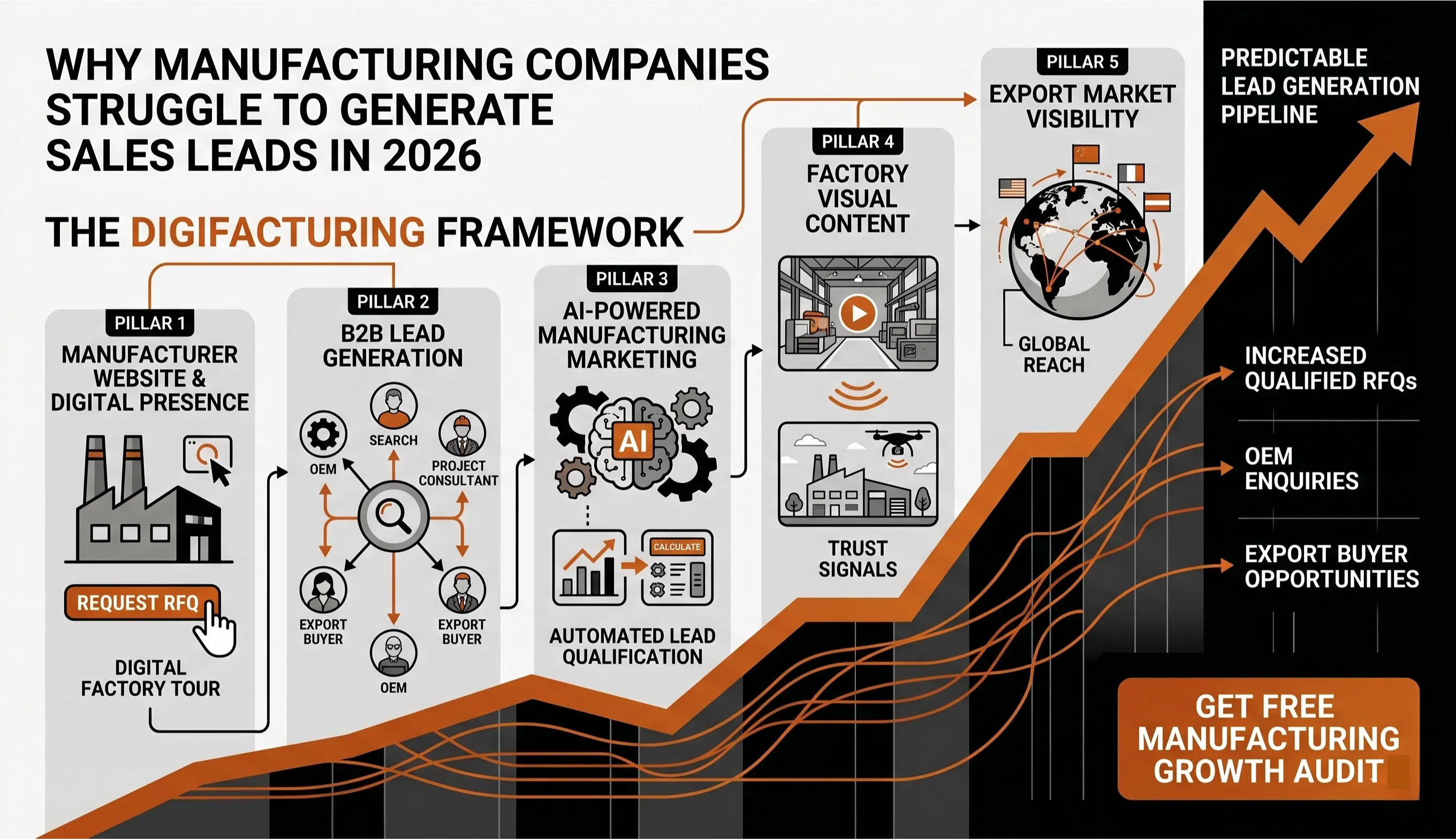
The Digifacturing Framework - Five Pillars
At Manufacturing Consultant, we call this transformation process Digifacturing. Digifacturing combines manufacturing expertise with digital infrastructure to create predictable lead generation systems. The framework is built on five pillars:
01
Manufacturer Website & Digital Presence
Your website becomes your factory's digital front door. The objective is to build industrial credibility, showcase your capabilities, improve search visibility, and convert visitors into enquiries. A strong manufacturing website communicates what you make, who you serve, how you manufacture, and why buyers should trust you - before a single sales call takes place.
02
B2B Lead Generation
Industrial buying cycles typically run between 3 and 12 months. Effective lead generation requires a multi-channel approach including industrial SEO, LinkedIn outreach, Google Ads, retargeting, and lead nurturing sequences. The goal is not traffic - the goal is qualified RFQs from buyers who are actively evaluating suppliers.
03
AI-Powered Manufacturing Marketing
AI allows manufacturers to scale visibility without proportionally scaling marketing costs. Applications include technical content creation, product explainers, lead qualification automation, campaign optimisation, and buyer personalisation. Manufacturers using AI-powered marketing maintain consistent outreach and content output even with small internal teams.
04
Factory Visual Content
Buyers trust what they can see. Professional factory visuals help demonstrate scale, production capability, quality standards, and infrastructure. Drone footage, production videos, and factory walkthroughs build buyer confidence faster than any brochure. For export buyers especially, compelling visual content is often what separates a shortlisted supplier from one that is overlooked.
05
Export Market Visibility
Many manufacturers have the production capability to supply international markets but lack the digital infrastructure to reach global buyers. This pillar focuses on building export-ready digital assets - including international SEO, export-focused product pages, and multi-market lead generation campaigns - that make it easier for procurement teams in the US, Europe, the Middle East, and Southeast Asia to find, evaluate, and contact your business.
Signs Your Manufacturing Company Has a Sales Visibility Problem
Your business may need digital transformation if your website generates very few enquiries despite reasonable traffic, sales depend heavily on referrals and a small number of existing customers, competitors consistently rank higher in online search results, trade shows generate limited ROI compared to the cost of participation, dealers or agents drive the majority of your revenue, or sales forecasting is difficult because enquiries are unpredictable.
Instead of tracking likes and followers, manufacturers should focus on metrics that connect directly to revenue: RFQs received, qualified enquiries, OEM opportunities, export enquiries, cost per lead, lead-to-customer conversion rate, and revenue generated from digital channels.
Business Outcomes Manufacturers Can Expect
When implemented correctly, a structured digital visibility and lead generation system delivers measurable impact across the entire sales cycle:
1
Increased Qualified RFQs
Instead of receiving random or irrelevant enquiries, manufacturers begin attracting buyers who are actively searching for their specific products and capabilities. This leads to better enquiry quality, higher conversion rates, and reduced time spent qualifying leads.
2
Reduced Dependence on Referrals
Many manufacturing companies generate the majority of their revenue from a handful of customers. A digital sales infrastructure helps diversify the customer base by continuously attracting new prospects, reducing business risk and improving revenue stability.
3
Predictable Lead Generation Pipeline
Rather than waiting for trade shows, references, or repeat customers, manufacturers create a continuous flow of opportunities. This enables consistent monthly enquiries, improved sales planning, better production forecasting, and sustainable business growth.
Manufacturing companies no longer compete only on quality, pricing, or production capacity - they compete on visibility. The manufacturers that become easiest to find, easiest to trust, and easiest to evaluate digitally are the ones that win more RFQs, distributor relationships, OEM contracts, and export opportunities.
Ready to Discover Why Your Competitors Are Getting More RFQs?
Connect with Tarun Gurwara and book a free 30-minute Digifacturing audit for your manufacturing business.
Frequently Asked Questions
EntityCommercial
What is Digifacturing?
Digifacturing is a manufacturing-focused digital transformation framework that combines industrial websites, lead generation systems, AI-powered marketing, visual credibility assets, and export market visibility.
EntityCommercial
How can manufacturers generate more RFQs?
Manufacturers generate more RFQs by improving search visibility, creating technical content, showcasing their production capabilities, and implementing structured lead generation systems.
EntityGeo
Why do manufacturing websites fail?
Most manufacturing websites act as digital brochures instead of buyer-focused sales assets. They fail to communicate capability, trust, and technical expertise in a way that encourages qualified buyers to make enquiries.
EntityCommercial
Can small manufacturers generate leads online?
Yes. Small and mid-sized manufacturers often benefit the most because digital visibility helps them compete with larger companies for the same contracts and OEM relationships.
Commercial
How long does manufacturing SEO take?
Most manufacturers begin seeing measurable visibility improvements within 3 to 6 months, with stronger lead generation results typically appearing within 6 to 12 months.
EntityGeo
What should manufacturers measure instead of likes and followers?
Manufacturers should focus on metrics that connect directly to revenue: RFQs received, qualified enquiries, OEM opportunities, export enquiries, cost per lead, lead-to-customer conversion rate, and revenue generated from digital channels.
Entity
Why do export buyers miss Indian manufacturers?
Global buyers rarely visit factories before initial engagement - they judge suppliers entirely on what they can find digitally. Manufacturers without strong digital assets frequently lose export opportunities to competitors with comparable production capabilities but better online visibility.
EntityCommercial
What role does AI play in manufacturing marketing?
AI marketing for manufacturers helps businesses improve visibility, automate repetitive tasks, and engage buyers more effectively. Applications include AI-powered content creation, lead qualification automation, campaign optimisation, and buyer personalisation - enabling consistent output even with small internal teams.
GeoCommercial
Where do I start with manufacturing digital transformation?
Start with a free 30-minute Digifacturing audit. This assessment identifies the specific credibility, visibility, and pipeline gaps currently costing you RFQs - and provides a clear roadmap before any work begins.
Start Generating Direct Leads Today
Ready to Build a Predictable Manufacturing Sales Pipeline?
Book a free 30-minute Manufacturing Growth Audit with Tarun Gurwara. In 30 minutes, you will walk away with a clear picture of where your manufacturing business stands digitally - and exactly what to do next to generate more RFQs.
Ahmedabad, Gujarat, India · Virtual Pebbles · Tarun Gurwara